Wednesday, 26 March 2014

Great Expectations - Part 2

Read part one onf the post here

A very popular story taught in moral science classes speaks of a king who ruled over a prosperous land, was very wealthy and rich, and loved a lot by his subjects. However, the king could not sleep at night due to some anxiety or depression. Lot of physicians examined the king and tried to suggest a remedy for this unique problem but none of them seemed to work. Finally a learned priest examined the king and told his ministers that all the depression and anxiety would be cured, if the king slept for one night wearing the shirt of a happy man!

The ministers thought it was such an easy thing to find a truly happy man, as the country was vast and fertile and everyone in the kingdom were rich and prosperous. However, when they went in search of a truly happy man, they realized that everyone in the country had one or the other reason to be worried. The minister said that he fought with his son, the dukes said they were troubled by the turmoil in the neighboring states, the farmers were worried about making more money for the future, and so on and so forth. The search party was about to give up their quest for a truly happy person, when they found on the streets, a beggar happily singing and whistling.

Upon speaking to this ragged poor man, they found out that this man was truly happy. He had no money, no home and lived on the streets. But he seemed happy and content with what he had and expected no more. They took him to the king, only to realize that this beggar had no shirt!

****

A bunch of MBAs including me reported for work in a new company after college and we were immediately put through a rigorous training session, which involved us picking up technical skills like programming, data crunching, the ubiquitous office, statistics and analytics – all in a span of three to four weeks. And at the end of the month, there were back to back tests which grilled on all these topics.

On one fine day, there were two tests scheduled – one in the morning on data models and SQL, and the afternoon exam was on MS-Excel. Although I was very confident on programming and statistics, the data pull or SQL was something which I was being introduced for the first time. And all the questions asked very tricky. After spending sometime in the industry, I now know that all these questions were direct rip-offs from the now so familiar stack-overflow.com. But that time, all the questions seemed very difficult and I fared really miserably. During the lunch break, I was feeling so down and depressed, I did not want to eat nor wanted to study for the next exam. I just went to a meeting room and sat there thinking. A tear or two escaped from my eye. And usually sadness leads to more sadness. I remembered about the tough part I was going through even on the personal front and life seemed so depressing at that point. I had fared so bad in spite of being very passionate – be it the profession or the personal relationship!

It is at that moment a realization hit me. It just struck me from nowhere but the thought was very powerful – “In life there are no successes or failures. It is just that you/someone expected too much or too little from yourself!". That was enough to immediately calm me down and stop feeling depressed! I smiled at the simplicity of the thought. But it made perfect sense. We categorize ourselves as successful/failures only because of the expectations we set for ourselves. And if we do set unrealistic expectations, we are doomed to fail and feel sad more often than not. Quite simple, yet so powerful!

****

Consider this: By the time you turn 18 and are having a perfectly happy life in school/PU college, expectations are built up on getting into a very nice professional course. Suppose you do choose engineering (because, well, do you need a reason?) and get into an engineering college, expectations are built up aroung bagging the most coveted job offer from the campus. And lets say you managed to do that and landed in (where else?) the IT biggies, you feel successful and remain happy until you see your buddies planning to quit for better opportunities/higher studies. Again, expectations start building up and you feel tell yourself that you’ll be successful only if you got that coveted seat in the top ranked college. And after working hard you do manage to get into a top technology / management college, that’s when the expectations come in fours and sixes! … ‘listen ya! he is doing MS itseems, he should get atleast $120,000 package after college’ or ‘oye, heard she got into that top ranked MII, she will surely get minimum 50LPA package after two years’

Expectations are everywhere. And in today’s fast paced materialistic world, the expectations are never ending but always too high! People want instant results… They want a bike, a car, a house, and a eight digit bank balance by the time they turn 30! Graduates from engineering don’t want to go through the grind of technical jobs. They expect onsite roles in Amreeka within 2 years of joining! Fat people join gymnasium or aerobic and expect to lose more than 10 kg within a month! Even though their parents might have served in the same position for more than a decade, professionals expect promotions every year! Isn’t this too much too soon? And what happens when these expectations don’t get fulfilled? Depression, stress, anxiety, visits to career counsellors, psychiatrists, drugs, anti-depressants and what not! Do we really need to go down that route?

Even relationships are not exempt from this unrealistic expectation menace. Everyone wants that perfect partner who understands them without even having to speak or struggle. They conveniently forget the essential communication aspect which goes into making a relationship work. And adding to all this is the self-glorification tactics due to the advent of social networking sites. Even before you get to know the person, your expectations are set so high that the relationship is on thin ice even before it has begun. How often have you seen marriages/relationships fail these days due to mis-communications/failed expectations. And then there are few of those relationships which you never thought will last but have continued to do well just because the couples involved were willing to talk and set the right expectations.

The next time you feel really depressed or sad for someone/something, just pause for a moment and think – was it because of setting the expectations wrong? Maybe you under-estimated something or did not factor in some important considerations. More often than not, communicating and resetting expectations helps a lot. On that day when I realized this in between the exams, I just said to myself, ‘alright! Maybe I have fared bad in this one skill. That does not mean I have failed. Let me continue to focus on my strengths and achieve some quick wins. I can always come back to the weak areas later’. I went back to the next exam with a totally different approach...and yes, I did really well :)

A lot of people expect things for themselves because of comparisons they make with their peers. If you did really well in your job and did not get that onsite offer which your friend got six months ago, just sit back and think for some time. The situation was different, the evaluation criteria were different, and there was an entirely different scenario then. And instead of fretting about it and sulking, just speak to the leads involved and set the expectations very clearly so that next time you are clear on what you wanted. Success might not come exactly when you want it, but do realize efforts do pay off sooner or later. And yes, don’t just feel sad because you don’t have things in your life. Life does test you a little bit before things start going the way you want them. As the street urchin in the above story proved to us, if all that you expect is happiness, you can be happy even without a shirt. Right?

PS: Title credit - Charles Dickens famous novel. Used it as it made sense. Copyrights belong to their respective owners :)

Sunday, 23 March 2014

Great Expectations - Part 1

“Amazon reports 45% drop in profit! Investors cheer and invest some more”

Amazon is the world’s largest online retail store. It has been in operation for over 20 years now. From its humble beginnings in the m-commerce sector, Amazon has now expanded to all things digital – from providing solutions to big data and investing heavily in computer controlled instruments. It made quarterly sales of $17 billion in the Q3 of 2013, and yet the profits it generated were almost zero. In spite of this, investors believe Amazon will make money in the future and hence, they keep on investing, regardless of whether the company posted very less profits or outright losses.

****

“Nokia sells 15.7 million smartphones!!! Investors, however consider the outlook to be gloomy for the world’s largest mobile phone manufacturer!”

This happened in 2008, when Nokia was the still world’s largest cell phone maker. It had 40% of the world’s smart phone market share. It had recently launched its touchscreen device, 5800 Xpressmusic and was investing heavily in a lot of diverse platforms (Symbian/S60, meego, S40, etc) to counter-attack the newest entrants in the market – iphone and android. And although things looked promising for the future, investors had already started to expect the decline. The CEO’s actions or statements did nothing to re-assure them and win their confidence.

****

“Facebook acquires whatsapp for $19 billion”

Whatsapp is an instant messaging service. It has revolutionized the way people used their phones, by providing a simple data based platform with which users could conveniently exchange texts, and media. From its humble beginnings in 2009, Whatsapp was valued at $1.5 billion and had a user base of around 200 million active users. And within a year, facebook bought all of whatsapp for a whooping amount of 19 billion dollars, leaving the financial pundits perplexed. How could it command such a premium?

****

“Inspite of critics giving it a total thumbs up and technically well made, fiza bombs at the box office”

Fiza was Hrithik Roshan’s second movie in Bollywood. It was a movie with a well written script, well directed and all the lead protagonists acting so well. And inspite of all of this, the film was a disaster at the box office. Why can a movie fail after being so well-made?

****

Do you notice any connection in the above stories? For me, a common theme underlying in all these stories is expectations. Whether in business/ sports/ cinema/ politics, managing expectations is one of the toughest of tasks. If you succeed in this one task, anything else will hardly matter. Let us look at the Amazon example, why is it managing to attract investors inspite of failing to make money for the last 18 years? The answer lies in how the expectations have been set by the CEO. Mr. Bezos wants to set up a retail shop for the future! Whatever money the firm makes (and it is really a lot!), he goes on and invests in warehouses, hiring skilled people, robots, and what not. Amazon is promising to create a future with more cash for the investors, and hence, they are not worried for the moment. The same holds true with the acquisition of whatsapp; Even though the current worth of the application might not have been so much, analysts at facebook expected that the firm is much more valuable as it can generate money in the future. Not to mention, the variety of potential business models it could build up in the future by combining a smartphone based IM service, and their very own social networking. And no price seemed too much for having that control in this previously unchartered territory!

On the other hand, failing to meet expectations is something which can get down even the biggest of companies or stars. What killed Nokia was the fact that the top leadership failed to set the right expectations with the investors. During the time when Apple Inc. came up with an iphone and Google announced the open source android, Nokia virtually ruled the smartphone market (almost a 60% share in the market). Both the competitors had very promising device portfolios and nice products lined up for release, and the mobile telephone giant was totally unprepared for such an onslaught. Instead of focusing on getting their strategy right, they went all over the place, going back and forth on the choice of the OS, the choice of their CEO, and on almost everything. Investors lost faith in the company’s ability to take on the mighty competitors. They started pulling out their money. Nokia lost the battle without even fighting!

Perhaps no other Bollywood movie star has stepped into in the movie industry with so much of commercial success and hype as much as Hrithik Roshan. His debut ‘Kaho Naa.. Pyaar hai’ was a roaring success, and a runaway hit at the box office. It broke almost all records at the box office, the music stores and it bagged almost every award for the debutants in that year. Hrithik became an instant heart throb among the Indian female fraternity. So, naturally expectations started to build up when the promos of his second film started to surface. However, ‘fiza’ was a completely different movie as compared to the box-office pleasing romantic melodrama that kaho naa.. was. And hence, the expectations of the audience watching their star in a completely different role were grossly unmet. It was not because ‘fiza’ was a bad movie that it failed. It just failed because people had set very high expectations for the movie after the ultimate success of ‘Kaho naa..’

Expectation management is a very complex thing in itself, something like an art as well as a science. The success of any project depends upon how the expectations are set in the beginning and how the team works towards meeting those expectations. And a very crucial attribute that helps to get expectations right is communication. The importance of communication cannot be emphasized enough. Even at the cost of over-communicating, it is always better to talk to the people involved at regular intervals and make sure that they are aware of what to expect. Very often, projects go bad and draw flak from the stakeholders only because they were never told what to expect at the end of the project.

The other day, we went to a pizza outlet that advertised a ‘meal for two’ at Rs.500/- The person who took the order went on to suggest lot of modifications to the so called meal, without mentioning the costs. We just took what we thought were some reasonable additions (say an extra topping to a veg pizza, crushers instead of cola, etc). However, the final bill came to more than Rs 1200/- which certainly left us fuming and grumbling. That is when we realized that neither of us had bothered to change the hitherto set expectation on price. The waiter thought it was just fair that we pay because we were ordering something more than what was on offer. We just assumed that a little addition would not inflate the bill to more than 100%. Adding just an extra roti and masala chaas to an already advertised full meal, would not just double/triple your bill! Right? We paid up anyway, having learnt a valuable lesson for future eat-out experiences.

Because it is so critical in all professions, expectations management is slowly finding its way in the curriculum of most formal business management courses. It would be nothing more than a more formal course is communications, relationship management and diplomacy, but it is still important nevertheless. Even businesses realize that it is better to be forthcoming on their prospects and set the right expectations, than be secretive on information, which is only going to hurt in the long run. People never panic when things go as per some “plan”, however bad the plan is. In the concluding part of this article, we will see how expectation management applies to not only everything we do in professional life but also to our personal lives. If you have encountered things going wrong because of setting wrong expectations, or if you found things in this piece interesting, do let me know through comments. Set your expectations right and then success will be yours. All the best!

Continued in Part 2... here

Sunday, 6 October 2013

The two T's

As MBAs we are all quite familiar with the 4 Ps of marketing or the five forces of strategy. But only KGPians will know that there are 2Ts which form an inseparable part of our stay here -'Trains' and 'Technology'. These 2Ts have fascinated me all my life. The long whistle of a zooming train in the middle of the night used to stir up my emotions like no other and I used to yearn for going on long train journeys. In a similar manner, technological advances which made life easier for the humankind never ceased to impress me. When I was a kid, I used to visit my uncle’s place only for two reasons – to explore a new computer that they had bought which was a rarity in those days, and to stand on the terrace of their house and wave hands to passengers on the trains on the Bangalore-Mysore route. So, when I finally got admission in the railway and technology town of Kharagpur, there was little hesitation in quitting my job and coming here.

HWH-YPR Duranto

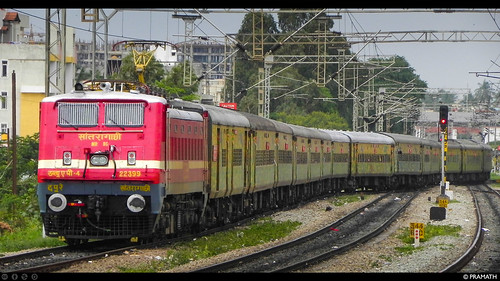
16383 KGP WDM-3A awaits signal amidst slight drizzle while shunting in the rakes of 12245 Howrah - Yesvantpur Duronto Express. Taken on 22.06.2013(Saturday)

Kharagpur is home to the longest railway platform in the world and is a major junction for the Indian railways. All trains on the East-South and East-West routes invariably pass through this station. Equally famous in Kharagpur is the Indian Institute of Technology, the first of the world class engineering institutes started in India. The IITs are known world over for producing the best quality engineers year after year.

The beautiful Kharagpur railway station, at km 114 from Howrah on the South Eastern railway

But the only dilemma facing me when I got an admission was whether a management course in middle of a technology hotspot was the right choice or not? After all, location seemed to be the most important thing in choice of a management institute. Would the two years in a remote place like Kharagpur be as rewarding as some of the self-advertising, money squeezing B-schools in other financial hotspots of India? It was a tough call to take but the experiences in my work life came to my aid. I had observed the daily issues in the company where I worked – one of the technologically admired companies in the world. I realised that technology had the highest scope for management. It is relatively easy to manage small scale industries or firms which operate under little number of constraints. But the real challenge for a manager lies when the technology gets advanced and quick decisions have to be taken under a wide variety of constraints and limitations. And how well a manager uses this technology to improve the daily activities in the company determines the success of the company. No wonder then, we see a large chunk of MBAs having engineering backgrounds. With these thoughts in mind, I left all the comforts of my workplace to be a part of this technology hub in middle of the jungles of Bengal.

The first Indian Institute of Technology was established in the year 1951

Universities across the world have management schools which offer under-graduate, post-graduate and doctoral programs in management. The number of management institutes in the world has only grown in the past few decades, and we have around 3500 management institutes in India alone offering the once prestigious MBA degree, compromising on the cost and quality of the same. However, this was not the case in the early years of the modern corporation when the new B-Schools were set up in the world like Wharton School of Business in 1881 or the Harvard Business School in 1908. The premier technology institute, MIT, foresaw the need for creating specialised courses for technology management and created the MIT School of Management which later came to be known as MIT Sloan School of Management. In India, IIT Kharagpur was the first technology institute to recognise the need for such techno-managers and with sufficient funding from one of its alumnus Vinod Gupta, opened up the first IIT B-school in 1993 – the Vinod Gupta School of Management

Vinod Gupta School of Management is one of the most beautiful structures inside the IIT KGP campus


There is technology everywhere inside the IIT campus. People here are so obsessed with technology that even the hospitals, clubs, swimming pools, and gymkhanas inside the campus have the prefix “technology” attached to them ? Work on the cutting edge technology for the next generation happens here and an expert in any field is right in the department opposite yours, if not in the same department. We got exposed to so much of technology here and felt that we could be aptly called as “techno-managers”. No other costly B-school claiming to have a location advantage could have given us the same exposure to technology.

People are so obsessed with technology here that all sport/recreational places inside the campus have the prefix 'technology'- Technology hospital, Technology guest house, Technology sports gymkhana, etc... there is even a technology swimming pool where all technologies swim together :P

While I relished the two Ts that define Kharagpur, there was one important thing I had missed – there is little else apart from these two Ts here. For someone coming from a big metropolitan city, the difference was immediately obvious – no motor vehicles inside the huge campus, no shopping malls or multiplexes, no choice of fine restaurants, not even street lights on the road outside the IIT boundary wall. It took some time getting used to the life in midst of greenery, cycling through the huge campus, the humidity of the place and the food at the hostel (even the mustard oil). But the journey was made very easy, thanks to the friends that I made here. Having stayed and worked in one city all my life before, the kind of diversity that this place offered me was simply amazing. One thing that was common to everyone studying here was the determination to succeed and the motivation to keep going despite many hurdles.

One fourth of my MBA life is already over and even as I write this article sitting in the comforts of my house during the semester break, I am filled with a sense of pride of being a part of a great institute and a deep desire to go back to the two Ts which have influenced my life all along... to the greens of Kharagpur, to all those places where we roamed around in KGP, and to the place which I have come to know now as my home away from home.

PS:
1. This article was written by me when I was pursuing my MBA at Kharagpur. It was published in the college’s annual alumni magazine. It is reproduced here with minor modifications and slight additions. You can read the original publication here
2. KGP - the station code for Kharagpur, and KGPians - people who stay/study at Kharagpur
3. Few images are copyrights of their respective owners, used here only for representative purposes. Specially those of the trains and stations, will reference the orignial links from the original source


Thursday, 26 September 2013

Melodies - Part 3 : That revolutionary codec!

To read Part 1 of this post, click here
To read Part 2 of this post, click here

At around the same time CDs sold like hotcakes and planet M bosses were laughing all the way to their banks, a ground breaking technology was already gaining ground and finding its way onto computers. Using an inherent limitation of human auditory system known as auditory masking, scientists at AT&T Bell labs were fine tuning some algorithms in the late 80s and early 90s. And sometime in 1991, a committee known by the name of Moving Picture Experts Group (MPEG) adopted a lossy compression algorithm submitted by a Mr. Brandenberg as a standard for compressing audio files – MPEG – 1 audio layer III or more commonly known as MP3.

So, what exactly did this MP3 do? It used a lossy compression algorithm to discard all the unwanted bits from the audio file and compressed it into just 1/11th of its original size, which meant that a 5 minute song would now need only 4.6 MB instead of 50 MB!! Of course, there would be a little loss in the audio quality due to the compression, but that is where all effort of the scientists/researchers went into – to make sure that the drop in quality was too small to be noticed by the listener as compared to the significant savings in space required to save the file. This file would then require something called a CODEC – a coder decoder software which would uncompress the file and play the music encoded in those bits. It was not long before the codecs were developed using programming languages and distributed to computers leading to the launch of this:


Nullsoft’s Winamp, which installed and played that whipping llama introduction immediately after install was one software which totally revolutionized the way people saw PCs. If you had a PC that ran Windows, there is no way that you could have missed this software (unless ofcourse, you were a media player fanatic who thought WMP was the best thing that could have happened to Windows). By the beginning of new millennium, the MP3 codec was so ubiquotuos in PCs thanks to software like Winamp and WMP. But wait, if they could build a specialized computer device that played audio CDs, and they could build a universally available codec for playing MP3 on a computer, could they not merge the two?? Well, it was only a matter of time that this happened and we saw the emergence of these:


The Mp3 codec enabled Mp3 players were a totally unprecendented innovation in the music industry. Even when gramophone was replaced by the cassette player, the changes were not that disruptive. And as always it was met with strong opposition from the music industry who feared revenue losses by the unauthorised use of such files. They had every reason to be worried –but even with their scepticism, there was nothing that they could to do to stop the spread, because unlike a cassette or a CD which has a physical form and easy to track, there was very little knowledge among people on what a file is and where all it can be stored. A file is just virtual entity and can be present everywhere – on a mobile device, on a USB storage disk, on an encrypted/hidden area of the disk, or even on the internet (on the cloud). For that matter, one could just change the extension of .Mp3 files and no one would know what these files stored anyway, unless they knew more about computers and files. (Yes, there were a lot little people who knew about computers then as compared to today)

Those were the days of a booming PC market, combined with the entry of feature phones in India and the possibilities of having a high quality song reside in the form of a 5 MB file were limitless. With MP3, you could have almost 200 songs reside on a single CD and play it for hours together. With MP3 stored as files in your personal computer, you could choose the order of songs which you wanted to listen, and not stick with the same order that the cassette player played. You could even build your own playlists with only hits and choose to ignore or totally delete (SHIFT+DELETE) those unwanted songs. While playing ‘Rangeela’ songs on a cassette, I used to hate the fact that I had to listen to a rather boring ‘HAYE RAMA’ immediately after Asha Bhonsle’s hit song ‘RANGEELA RE’. After I got winamp on my system and an MP3 player at home, I have never listened to that song in almost 15 years now!!! With MP3, you could transfer a song onto your friend’s PC and it played with exactly the same quality as the original. With an MP3 player and just one MP3 CD on your car, you could travel 350 kms from Bangalore to Mangalore, without ever having listen to the same song! Combined with other add-on technologies which were launched that time, MP3s totally destroyed the AUDIO CD market in just a matter of 1-2 years, something which the cassette could not have done to gramophone in more than a decade. Which meant there would be no more of these:


And there would be emergence of single person, noiseless, non-disturbing headphones/earphones, where no one could make out what you are listening to. Something like these:


Apart from the fact that MP3 songs were of superior quality, they came packed with lot of inherent features: take the ID3v2 tag for example – you could store upto 20 fields of information embedded into the file itself. There is no need for any inlay card or additional details outside of the file – even the album art can be stored into the file itself. Easily available software allowed cutting of the files which was again a welcome feature, especially in some songs such as ‘aisa zakhm diya hai’ where you had to wait for like eternity till the nice part of the song set in. And since the codec was found on almost every mobile device, sharing of songs became child’s play. If I bought an audio CD and ripped it to MP3, I could use the same file on my mobile, my home audio player or any device and be assured of the same quality. Of course, the logical extension of this would be privacy – since there was ABSOLUTELY NO loss in copies of MP3, anyone could make any number of copies of a song and distribute to whoever needed them. The exclusivity of owning songs/music collection immediately became a thing of the past – all that mattered was how much the disk could store and people could store all the songs that bollywood has ever produced with them! Although, I liked the fact that more people now got a chance to listen to music than the proprietary cassette/CD days, what hurt me most was that absolute morons who had no sense of music now stored virtually every song ever composed (even the great, timeless compositions) without any intention of listening to all them!

Cut to present day – the digital revolution has created superabundance in almost every aspect of the music industry. There are like umpteen technologies which compete with MP3 like WMA, aac, avi, mp4, RM and even the proprietary ones like itunes/zune audio. There are a million ways to buy music – internet downloads, mobile downloads, online marketplaces like Amazon/flipkart, itunes shop and what not! There are again a thousand device types on which you can store music – DVDs, mobiles, memory cards, flash drives, hard disks, ipods, the internet CLOUD, etc and I don’t even have to tell you where all you can listen to songs. And the option of selective listening has taken a new meaning altogether. We have the option of buying just one song or in some cases, just parts of a song to set as ringtones. Those days, we were forced to listen to many bad songs in a movie just to listen to one great song – but today, only one hit song of the movie gets downloaded leaving the others as “also theres”. I don’t think i will ever get time to listen all songs of ‘Aashiqui2’ anytime even when that is touted as the biggest hits of 2013!

The problem that the end-user faces is not that of lack of music but an overexposure to it. If you like ‘kolaveri di’, you can have it as your alarm tone, your call ringtone, your message alert tone, your hello tune, the default song on your ipod/phone, create a ‘i love kolaveri’ page on facebook without knowing what kolaveri means :P, listen to it while you drive, and even watch it while at work if your company is benevolent enough to allow youtube! And all this, without even having to know which movie the song is from and which are the other songs of that movie! Guess it’s time to throw all the ‘marginal satisfaction’ theories of economics out of the window ? The only things that have continued to remain exclusive are some of the shows/tidbits on FM Radio (for example, I eagerly wait for SULTAAN on FM94.3 to learn two English words daily! :)

My original purpose while writing this blog was to delve into listening experiences. I know that every time we listen to a song (regardless of how many bits coded/decoded/compressed on what device), there is some feeling which you experience – maybe you go off to the sunflower fields of Punjab while you listen to 'Tujhe dekha to', maybe the Darjeeling train comes to your mind when you listen to ‘Mere sapnon ki rani’ or you totally associate the song with a personal memory – but poignant listening experiences are those when you get completely lost in the song. I wanted to write about some of such awesome listening experiences which I have had till now. But I guess, I let my technology instincts take over:) Anyway, I plan to write more on the same in the coming posts. Till then, I would want to know from all of you on some of the best listening experiences which you have had till now. Drop me a note or leave a comment below about such wonderful experiences you might have had. I’ll come back soon with some of my own. Till then, happy listening.

NOTE: There has been a lot of talk about all this digital revolution has put the artists in losses because of piracy issues, which is not totally baseless. I understand that due credit should be given to the composers. Apart from the sound which I recorded, I have always been used to buy cassettes and Cds and had a nice collection of these till very recently. But that does not mean we should do away totally with convenient formats like “MP3”/”WMA” just because of the threats. At the end of the day, even with their vulnerability, the fact remains that technologies like MP3, mp4, avi, etc have let a lot more people experience, enjoy and appreciate music instead of limiting it to a few elite. Because it is very easy to share, well made audio and video can go viral in a matter of days (even hours sometimes) earning a lot of traffic and revenue for the producers. In turn, this has encouraged more and more people to take up careers in the digital music and recording industry. We see a lot more people employed in the music industry today than before, which cannot be a bad thing, right? And then there a lot of options like mobile formats, ring tones, hello tunes, itunes, etc each of which can be major sources of revenue for the artists by their sheer volumes. Steve Jobs got it right when he thought of pricing per song instead of selling an entire album. Today, lot of music sales happen by song. And I am sure we can work out pricing issues amicably such that the composers and artists get their due, eliminating all the middle men and unwanted costs, thereby creating a win-win situation for composers and listeners.

PS:
1. Images courtesy: Google images and Wiki images. All images are copyrights of their respective owners, used here purely for illustrative purposes
2. WMP : Windows Media Player - a prorietary music playing software that comes pre-loaded on MS-Windows Operating systems. It plays MP3s and also supports compression on its own proprietary format - WMA (Windows Media Audio)